Beautiful in His Eyes

The golden fish may carry scars,

she may have wounds, maimed fins;

she ages, moving more slowly,

but she swims on, giving thanks

for the beauty that still exists around her.

She cannot know what is ahead,

what further challenges,

or how far she has to go;

she swims because

that is what God created her to do,

And she is beautiful in His eyes.

Suzy Roeder, December 2019, London England

Tradition

Tradition. It is the title of a famous song from the movie, “Fiddler on the Roof.” In the movie, tradition forms the framework of society and culture. There seems to be a negative side to almost everything that is considered good. Ice cream is delicious, and yet if we over-indulge it causes negative effects on our health. In the movie, the father’s love is tested when one of his daughters marries out of the traditional path, and another of his daughters wants to marry a man from a different religion. Faith and religion are arguably very good, but can go wrong if fueled with selfish or errant intentions.

Some traditions are inherently errant. Most would agree that stoning, maiming of women, or slavery are inacceptable, inhumane practices; these are traditions gone way wrong. But most traditions are positive for society, and perhaps essential. Some people may link tradition negatively to verses in the Bible when Jesus spoke about the Pharisees, but he was commenting on their hearts and intentions. In reality, Jesus followed the traditions of his Jewish people in an exemplary way.

Traditions serve to form the framework of society. I grew up in the Episcopalian Church, and it was traditional to be baptized young, and confirmed when a teenager. It was wonderful and very meaningful for me, forming a healthy world-view of humanity. A daily tradition in our family was to eat dinner together when my father returned home from work each day. A yearly tradition was to celebrate Christmas on Christmas Eve, which was from my mother’s Austro-Hungarian heritage. Life had structure every day, every season, and we grew up feeling a sense of security, our lives responding in very healthy ways. We learned to value others and respect them.

In regard to Baptism, some churches perform these early in life, some perform them later, and some call them Christenings. There are people who argue strongly for one or the other. Some churches feel that others lean too heavily on tradition, and they quote certain verses from the Bible. In an effort to improve, change or reform a tradition, it is sometimes thrown out completely, in effect “throwing out the baby with the bathwater” as the American phrase describes. There is no real work to reform and it is just eliminated, often with violence or great unrest. When this happens, we can lose the most important aspects of the tradition.

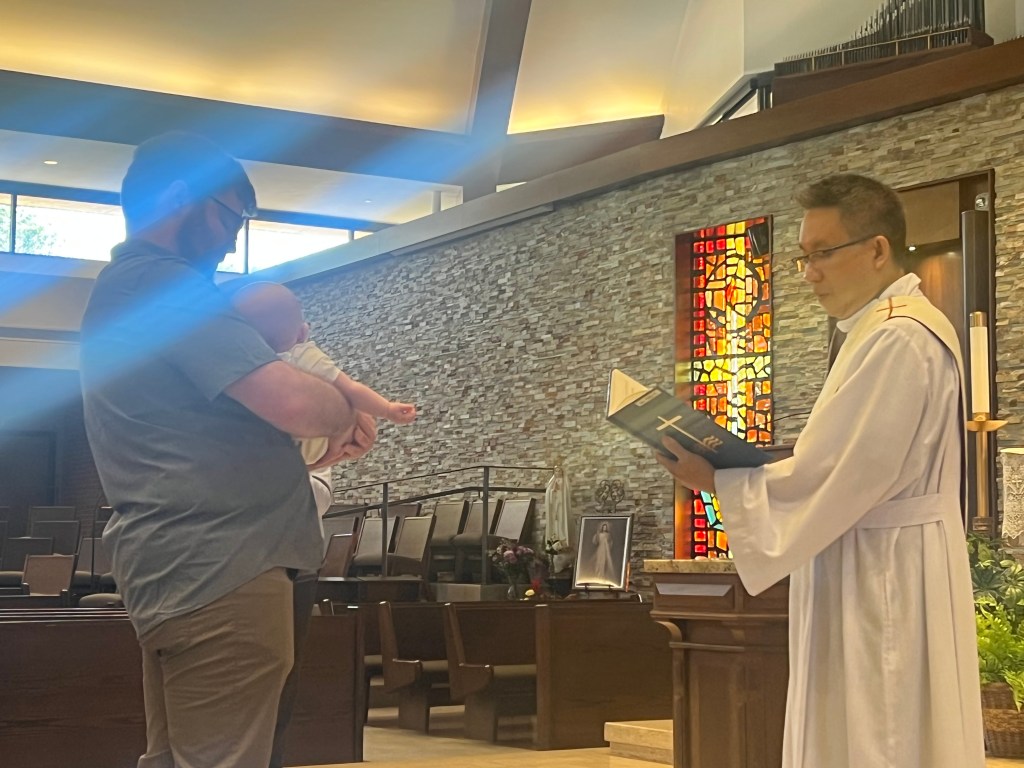
Our grandson was recently baptized. It could not have been more beautiful, save for more family being able to attend. Our son-in-law’s parents and one of two brothers flew in. The other brother, the baby’s Godfather, was out at sea with the Navy, but he was able to watch in real-time by smartphone. Our oldest daughter flew in to attend as the baby’s Godmother. Our grandson was peaceful the entire time. He is now almost six-months-old and smiled throughout. He fell asleep as the water was poured over his head in the name of The Father, The Son and The Holy Spirit. Just beautiful.

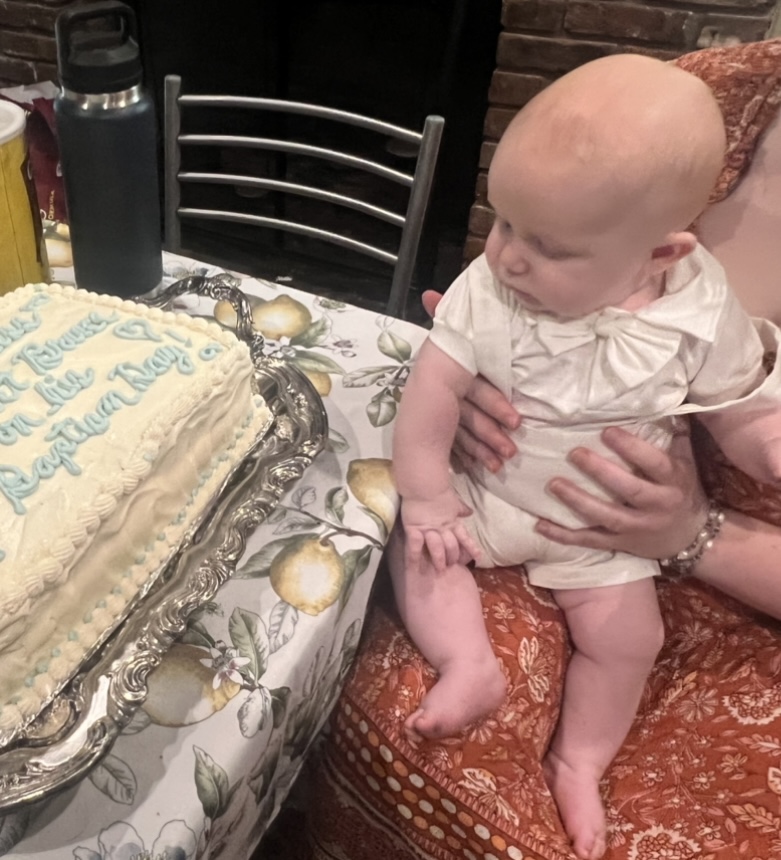
Afterward, my daughter and son-in-law had us all over to their home for a cookout. Gifts were presented, and elements from the baby’s great-grandparents were used, like the silver tray passed down from his great-great-grandmother, which held a cake. Over a dozen of us feasted and laughed and celebrated. Two families blended as one.

Tradition has the purpose and potential to form the framework of society, of culture, of family, of life. Good routines and practices are edifying, strengthening and restorative. I pray that you find yours, and that they bring you peace and joy.

Pendulous Times

Changes in the last few decades in the United States in regard to marriage, the dignity of life, self-empowerment, feminism, abortion, and racial issues have been significant. They have caused many to become angry, worried or even depressed–whether they feel that there have been too many changes, or not enough fast enough.

World-view and personal philosophy fuels how we see things and react. I try to resist black-and-white, linear or negative philosophies. I have read and re-read the Bible. I pray and I trust God with any matter in which I am confused or even disappointed. I do not wish for “X” country to be “nuked,” or for those “Y” people to go to hell. I do not believe that violent acts are the answer. In the big picture I believe that God’s got this. He is Love and therefore He is just and merciful. I still see much good in this world.

It is not relativistic to acknowledge that we are living in time. If there are alternate realities or eternity, well, we are still here and we cannot avoid the passage of time, aging and death. Our cultural climate will shift with time. My mind often analyzes concepts in images. The image of a pendulum helps grapple with the world and its polarized right/left, political and philosophical extremes. I think of the constantly moving, never static Focault Pendulum we visited as schoolchildren at the Smithsonian Institute in Washington, DC.

Standing on a high floor, looking over the railing we all stared, mesmerized, as the 50-foot-long pendulum swung slowly through the center of a large circle on the floor below below, reaching out to a point on the perimeter to knock over a pin at its furthest reach. It seemed still for a moment, but then reversed, and headed in the opposite direction to repeat the process, back and forth, slowly rotating round and round, eventually knocking over every pin on the circumference of the circle. The point of the exhibit was to prove that the earth rotated, but I believe that it can serve as a metaphor to grapple with the times, and to argue for love.

Throughout tragic events in history (slavery, concentration camps, genocides) there arose incredible individuals who led others, who helped and inspired despite their horrid circumstances. Fred Rogers famously quoted his mother’s advice, that in troubled times he should “look for the helpers.” Look for the heroes who inspire.

The pendulum reminds me that times will indeed change. It passes through the middle all too swiftly, where there could be more understanding and compromise. Times may shift as significantly as we’ve seen politically in the United States from one extremely different President to another. At one far reach of the pendulum of time something is outlawed, but at the opposite it becomes legal.

Be patient. There is a way through whatever mess you see. Heroes will indeed emerge. Maybe you are one of them. Keep focused on the good that still exists, and strive for love and understanding. The ability to have compassion and to stand in another person’s shoes makes life much more meaningful and full of hope. Love not only endures throughout the languorous swing of the pendulum through time, but it heals, and it brings us all closer to God.

Calming the Beast

In the 1980s I rode horses with my friend Judy. Judy was a timid rider at first; we covered the countryside on my friend’s hunters, horses used to traveling cross-country and jumping obstacles. Hours-long rides, covering hill and dale, hopping over logs and some man-made fences, we were challenged and grew in tenacity, all-the-while, laughing and making wonderful memories.

My husband and I spoke of hindsight bias the other day and I know that I have some, but I was strong and pretty fearless, confident in my skills. I will always treasure those memories as some of the best of my life.

“Winston,” an English Hunter

Riding one summer in Ireland along the rocky shores of County Sligo, one of the men had been put on a very large, very excitable horse. After 30 minutes he gave in humbly, and switched to my smaller, calmer horse. The big dark bay I was put on settled down and we finished the ride a few hours later. Was it my skill? Maybe, but I also believe it was due to experience with many horses and a lack of anxiety. Horses sense the rider’s calm.

At Rosses Point, County Sligo, 1984

Something began to change in my “calm, anxiety-less” demeanor after completing college, becoming a registered nurse and having children. My kids would now say that I am an anxious sort. I never used to be. Once upon a time I was the go-to person to get on the crazy horses because of my calm. What happened? I believe that with my education of disease processes, with experiences in traumatic injuries, and with the great responsibility a parent feels, I became a worrier. I do work on it, and it has lessened since the children have grown older. The worries are now more about their driving, or dating, or navigating this increasingly complex world.

Back in the 70s and 80s we watched a popular show called The Waltons. Set in Virginia in the depression era the series followed the lives of a wholesome, large family. I loved it. It seemed like we were lightyears ahead of those times with appliances, fast cars, chunky mobile phones the size of a brick; we were so much smarter and advanced. At the time I watched it, the depression era was 35 to 45 years past. Now, my days riding with Judy and riding in Ireland were 40 years ago. I look nostalgically back on those simpler times, much as my parents did while watching The Waltons.

The world has continued to advance exponentially. We now have immediate connection and knowledge at our fingertips with smartphones. The James Webb telescope is transmitting back incredible, challenging photos of the universe. Artificial intelligence has become a reality to the extent that experts argue on what limits should be set for it.

And yet, have we come as far as we would have thought, as far as we should by this point? I believe that this process of improving human rights is continuous. I do wish we were not so polarized and could work together more efficiently and diligently. Perhaps the news and social media have stewed a pot that was more manageable when not boiling over, out of control.

Judy is sailing with her husband this week. They are taking a break from the anxious world, instead, courageously navigating the Atlantic Ocean. Her daughter got word to her that I was thinking of her and our times together so long ago. I was told that she smiled thinking back to them, too.

Nostalgia and good memories are balm for the unrest around us. Gratitude is calming and centering. No matter the tumult around us, no matter the inability to get a “good bit in the beast’s mouth” and guide it right where we want it to go, we can sit astride it with experience and confidence. “Nothing is new under the sun.” Humanity has in many ways been here before, and our contribution of calm, of gratitude, can make a difference in the anxious world.

On “Justin” with my nephew. Justin, an ex racehorse, calmed beautifully over time.

Dream Griever

Life does not always go as expected. Despite how hard we plan and work, sometimes our dreams do not come true.

We may follow a healthy diet, but an illness or an accident suddenly changes everything. We might plan a certain course of study but then there is no job available, or life events keep us from accepting that dream job.

It is too easy to cast blame, become disgruntled and negative. What is healthier and necessary is to do the work of grieving the unattained life-course. Only then comes acceptance and the realization that where we are at this moment holds potential. We are each a work in progress; the masterpiece of our life is unfinished.

My friend Marilyn was ordained and educated at Boston University during the late 1950s and 1960s. She was mentored by civil rights and academic giants including Dr. Howard Thurmon and earned her doctorate to became a pastoral counselor. Marilyn longed to found a retreat center. She had a fully visualized plan, obtained necessary licenses, aligned herself with the right people, amassed supplies, furniture and know-how, ran many group conferences, and yet she never saw her full dream to fruition. She came close a few times. We spoke recently about how it was necessary for her to grieve this life-long dream.

It is easy for me to see all of the good that Marilyn has done throughout her life for individuals and for the communities in which she has lived. She does acknowledge some of this, but it has been important for her to grieve the original dream. She goes about this while at the same time dealing with severe, chronic pain issues and an adult daughter who continues to require significant support. Day by day Marilyn faces her challenges, continues to take one generative step after another, and strives to remain grateful.

Over coffee we caught up on events and made plans to tour a local botanical garden that features a “Monet Pond.” Marilyn will be 89 at the end of the summer. When I left her house she was taking a phone call from a young man seeking help with his girlfriend. As I closed her door I heard the tone of her voice shift to that of a caring professional. I quietly smiled, feeling proud and inspired.

Marilyn hasn’t created the retreat center that she’d always dreamt of but she has forever changed countless lives, including my own. I hope that one day she is fulfilled by the alternate, unplanned course in her life that blessedly intersected with ours.

Polyanna

If you have not seen the movie Polyanna with Haley Mills and Richard Egan, I recommend it highly. It is a children’s movie adapted from the book of the same title by Eleanor H. Porter. It is entertaining and moving. Polyanna is an orphan who goes to live with a wealthy aunt. Her life has been very difficult and yet she has adopted an attitude of gratitude and positivity that is her strength, and far from annoying, becomes inspirational to all who know her.

The word Polyanna has since been used as an adjective to describe unrealistic, starry-eyed idealism. Toxic positivity is a more modern and extreme concept today, purposely ignoring the actual distress of what another is going through. It is more dismissive than just a lack of social grace. I propose that ignorant bliss and the slang, synonymous interpretation of Polyanna is at one end of a positive philosophy, and toxic positivity is at the other. Both are extremes. At the center is a more balanced state, the actual example of the character Polyanna, and perhaps it is very much needed at this time.

I feel immensely blessed by friends from so many different walks of life. Rather than surround myself only with those who adhere to my beliefs, I am challenged by friends who have different theologies, philosophies and world views. Throughout the political ping-pong match of the last few decades in the United States I have witnessed a similar back-and-forth of reactions by those who hold one view or another. My prayer has been in each instance that hearts will remain hopeful, wills determined, anger channeled constructively, and heads cool. For those who are relieved or exuberant with various changes, I hope that they have compassion, not contempt, for those who feel the opposite.

In the news and on social media we see too many instances of rudeness and hatred. The constant presence of negativity on our televisions, computers and hand-held devices does great damage–if we let it. Fake news, strawman arguments and false narratives abound. If evil has a persona then its greatest tactic is to divide, then stand back and watch us destroy each other.

We can resist. We can strive to maintain peace and hope in our homes and communities. We can be more like Polyanna and inspirational, historical figures who despite poor odds and circumstances worked steadfastly, lovingly and peacefully for the good of others.

At the Core

Whatever your assumption about a particular apple, if the core is bad, then however it is prepared, you’ll likely end up with an inferior bite, or pie, or strudel.

Apple core? Every analogy breaks down somewhere. A bad apple can’t really be fixed, but we have the ability to fix core problems in society.

I see the problems around us but I know that in order to correct them there are no easy or quick fixes. Our polarized political system makes more of vilifying the other side and advancing self-seeking agendas than true reform, which is a difficult task at best. But we must keep trying.

Gun violence is abhorrent, and yet gun violence is not the only problem. There are still knives, fists, arson, bombs, cyber-bullying and other objects that can be and are used to harm others. There is no one fix to the problem of violence, because the problem is deeper and more complex than the method used. It is within the offenders. Our mental health system is in a terrible state, and our pediatric mental health system is even worse. Our culture is failing our young people in the formation of a healthy conscience, of a healthy body, of hope, and of individual resiliency.

My good friend, a decades-tenured college professor and wonderful, self-giving educator believes that education is the key. I would agree, except that it is not the only key. Earlier interventions are just as integral–including healthy prenatal environments and pregnancies, committed parents and guardians, and high-quality healthcare. No quick fix here, either. I believe that it is greed, corruption, fear and self-seeking that hinder efforts, that create future problems from impulsive actions, even when many deem those actions as needed. We are not great at evaluating long-term effects.

I avoid extreme arguments and stands because they rarely convince and they are rarely effective. The hardest work comes from getting into the most difficult of arenas, rolling up sleeves, examining evidence, arguments and proposed solutions, being willing to compromise, then agreeing on multiple strategies and preventative measures. Can we do this? Yes.

Will we? That is the question. We are up against much corruption.

Let us not fail. A divided populace is an impotent one. We need committed, selfless, caring citizens, advocates, lobbyists and elected officials to comprehensively fix problems at their core, to value and help our young people, our culture, our nation, and the world.

Though it was a recent meme on social media, the truth remains: We need much prayer.

Missing

Grief is a strange thing. Years may have passed and it hits, out of the blue.

People commented when only a few months after my late husband died, I met Bruce and fell in love again. Years later some new friends were discussing an Army widow who was remarried within a year and implying that she must not have really loved her first husband. Ah, mais, au contraire! I told them about my own experience.

My late husband’s practice partner, a wonderful, experienced Family Practitioner beamed when I first told him about Bruce. He said, “I know how much you loved Bob, and it’s because of that ‘once-in-a-lifetime’ love that you have the courage to love again.” Others probably thought I stopped grieving as soon as I found Bruce, but the process of grief continues. I like to believe that Bob went immediately to work in the afterlife, petitioning God for exactly whom he wished to be my husband and his little girls’ father. Grief is an undercurrent of my life now, slowly transforming into a firm foundation of gratitude. And there is much to be grateful for.

This morning I found myself unexpectedly sad, missing my Mom. She was an amazing, quiet, humble and steadfast woman. She was the rock of our family, and when Bob died so suddenly she flew from her home in North Carolina to be at my side. She remained with me and my two little girls until one day, nine months later, flew back to check on things in her home and passed away alone. My Mom and my husband were gone in less than a year. I take comfort that she was able to get to know Bruce and his girls, and was happy for us. So why am I missing her this morning?

There is something I believe about grief, that we never really stop grieving until we are reunited again. It is a process that teaches me to be thankful for all that has been given; yes, even the hard stuff. Not that I’d want any more difficulties thrown my way, believe me, but with trials we have the opportunity to become better people. I’m not talking about the phrase, “What doesn’t kill you makes you stronger.” No, somehow that negates pain and suffering. Each person has their own path in life, their own trials, and I can only speak on my own experience and those I’ve known or read about. There is at some point a choice to despair or to accept. Sometimes we need to fight–to find cures, to right wrongs–but eventually there is peace in acceptance. There is grace in trusting God, in being thankful for the good that was and still is.

If grief is a process, an undercurrent, then it stands to reason that at times there will be rip-tides that without warning pull me into the depths. I flounder until at last I stop fighting. I rise to the surface and allow the waves to carry me back to shore. At those times I remember, cry, and feel again the ripping pain of sadness. Then I pick myself up on the wet sand and walk toward the sun and the firm ground, with gratitude for the past, determined to love life in this moment.

Prayers and Saving Grace

I saw the movie “Benediction” last night. The beautiful and historic period piece was intriguing. Siegfried Sassoon, the English poet most known for his moving poetry about World War I wrote a letter after the Battle of Somme, declining further service. He was saved from Court Marshal and a death sentence through political and family connections, spending time instead at a psychiatric hospital. He formed very deep connections with his doctor and a fellow patient.

The film is worth seeing, but in my mind had some very loose ends that could have been more accurately and effectively tied. The movie softly jumps from one to another of Sassoon’s repeated efforts to reconcile the horror of war with a productive, meaningful life. There is a brief scene of his intention to become Catholic as an elderly man, and it looks like one more futile attempt to “save” himself.

A man who has previously had many affairs with other men, Sassoon marries a young woman, Hester Gatty, telling her that his whole future could depend on her. With Hester he has a son, and announces to party guests that this child is his future. She makes a comment that he said that once of her, hinting at the breakdown of the marriage.

It is not mentioned in the movie, but in the late 1950s he began to correspond with Mother Margaret Mary McFarlin of the Convent of the Assumption in Kensington. He introduced his niece Jessica to the nun, and she became Catholic. Jessica became a nun herself after his death. I’d like to think that he did find redemption in a belief system that gives meaning to life, to suffering, to difficulties, to attempts to find happiness in the flesh, to betrayals, even to horror.

Sassoon lived amongst famous writers, musicians, poets and royalty. His mother is portrayed in the movie by Geraldine James. She was actually an artist herself, a member of the famous Thornycroft family of sculptors. In James she exudes a sad peace, quiet and steadfast, beautiful and pained. Her younger son Hami is killed in the war.

Sassoon wrote a poem about her, To My Mother.

I watch you in your constant way,

In selfless duty long grown grey;

And to myself I say

That I have lived my life to learn

How lives like you unasking earn

Aureoles that guide, and burn

In heart’s remembrance when the proud

Who snared the suffrage of the crowd

Are dumb and dusty browed…

For you live onward in my thought

Because you have not sought

Rewards that can be bought.

And so when I remember you

I think of all things rich and true

That I have reaped and wrought.

Siegfried Sassoon

Late in life, yet not in the movie, another close relationship formed with a Benedictine, Dame Felicitas Corrigan. After his death she published a book about their friendship, including his correspondence with her. He wrote to her before his death:

All I know is that my pilgrimage has ended as a man before a crucifix finding sanctuary.”

As I see it, four women were “key to his future.” Mother Margaret Mary, Dame Felicitas, Hester, and his Mother each directed him toward the peace that passes all understanding.

Fungal Lessons

Maybe the title sounds odd. Lessons from fungus? In a previous post I related a few concepts, including tree root systems which utilize fungal pathways, to an idea of quantum entanglement. Here, I ponder something different.

I was speaking to a close friend the other day, and though we have different viewpoints, we stimulate each other to think about our opinions. We were talking about the polarization of our country, specifically in regard to politics. I’ve been thinking about it ever since. I strongly believe that if we try to understand what fuels someone’s belief system then we can avoid hatred and even polarization. It may not solve the immediate problem, but it can keep us on a more positive path and perhaps a more influential one.

After my friend and I had this deep discussion, I spoke with two other women, spiritual giants in there own ways. I also spoke with my husband, who is very balanced and also quite brilliant. What was their take on the polarization of this country? Three themes emerged:

1) Political division is not the problem, it is one symptom of the problem.

2) The jump that humans take to hatred toward one group or another is not the highest version of ourselves, and

3) The problems in our country (polarization being one) are not due to politics but of a culture of fear rather than love.

Fear fuels selfishness. Fear fuels hatred. Fear fuels corruption. When fear fuels our responses it becomes a twisted mess in which no one solution fixes the problem. Extreme actions often lead to “throwing the baby out with the bathwater.”

There is so much division in this country, in this world. Technology helps to connect, but it can also cause some to retreat and isolate. Human beings are meant for community. Some may of course feel less inclined to be “social,” and some may be physically unable to connect with others, but the optimal state of human life is in connection.

Interestingly enough, city planners in Japan used slime mold networks to double-check subway routes to determine their efficiency. The mold worked together to solve a problem. If fungi, if molds, if primitive life, exist in connection with each other, can’t we? And not just within our families, neighborhoods, cultures and political groups, but with all humanity. What is our network, our pathway to connection? Is it a spiritual one? Is it sending energy? Is it prayer? It certainly comes from a choice to move past fear to love.

Photo by Shane Rounce on Unsplash