Can’t Find It? Write It

I am lucky enough to have a trusted professional to speak with regularly. Dr. P is about my age and she has great experience. I mentioned in my last post that my friend Bev is encouraging me to write, and now Dr. P is also. I told her that as I watch YouTube I find myself hoping to discover someone in my stage of life who discusses multiple topics–not just makeup, or clothes, or a specific illness, or even health, but a variety of the things I find interesting, and the types of things I struggle with. I’d like to feel less alone and more inspired.

Not that I am without companionship. I am happily married, I still have three teenage children living at home, and a twenty-year-old who just moved back home to finish college online. I have friends but they are still busy with their careers or good health. I do not want to join a group; my energy and health are still too up and down to commit. So I watch YouTube and period dramas, and news. The latter is very divisive so I won’t get into that. I get things done around the house in bits, and struggle with the fact that I am so seriously less productive than ever before.

Someone I’ve recently heard about and watched on YouTube is a Harvard Business Professor named Arthur Brooks. Perhaps you know of him. He has lectured and spoken throughout the United States (and maybe the world), not about Business, per se, but about Happiness. The tie-in is that in order to be an effective leader and to have satisfied employees, one needs to know about the keys to happiness. Gratitude is essential.

Taking a tip from him I have instituted a practice of not just making a list of what I am grateful for, but very specifically choosing five things per day and really meditating on them, ideally as I walk. With the frigid temps these days I may not walk every day but whether I do or not, I spend some mindful time on five things. Three are supposed to be obviously good things, and two must be borne from suffering. Suffering? Yes. And for each, one meditates on three specific aspects of that gratitude.

So for example, today my obviously positive things were: 1) our family went out to dinner after church yesterday and I was grateful for the laughter, the precious time with family, and the means to do this (wow, dinner for six at a nice restaurant is pricey these days–we won’t do this regularly); 2) just the fact that I was out walking, I was grateful for the sun on my face, that my back could handle it, and that I could walk independently when there are others who have lost the ability to do so; 3) for my two new kittens, that Bruce allowed me to get them even though he pays for it and usually takes pets to the vet for me, that they are sweet and purr and are quite therapeutic, and that they are hilarious to watch.

The suffering-related things were: 1) I still have pain in multiple places every day, but the pain has drawn me closer to God, has allowed me to see how much Bruce truly loves me, and actually has pushed me to exercise more consistently; 2) my face was literally freezing in the bitter wind at that moment, but that discomfort forced me to think back to the many winters with frigid temperatures when despite them we got out and rode horses (the memories precious like gold) and I remembered riding a ski lift happily in Colorado high above the ground in the wind when the temperature was recorded as 18 degrees below zero (Fahrenheit!), and finally that I was grateful to be one step closer to home, and another, and another.

On other days I have had more profound thoughts regarding suffering, but those above were appropriate to share. A few years ago I created a post in which I later regretted sharing too much, and I do not want to that again; so, if you consider reading any more of my blog posts in the future, I promise–nothing awkward. Dr. P said if I don’t want to create a YouTube channel with the content I would want to see (I do not) then consider writing about it. A sixty-something-year-old taking some of Arthur Brooks’ advice is my first post. I will continue to learn about whatever else he suggests, and I may write more on it; however, there will be other topics. I am happy to hear your suggestions.

It feels good to write again. Thank you for reading!
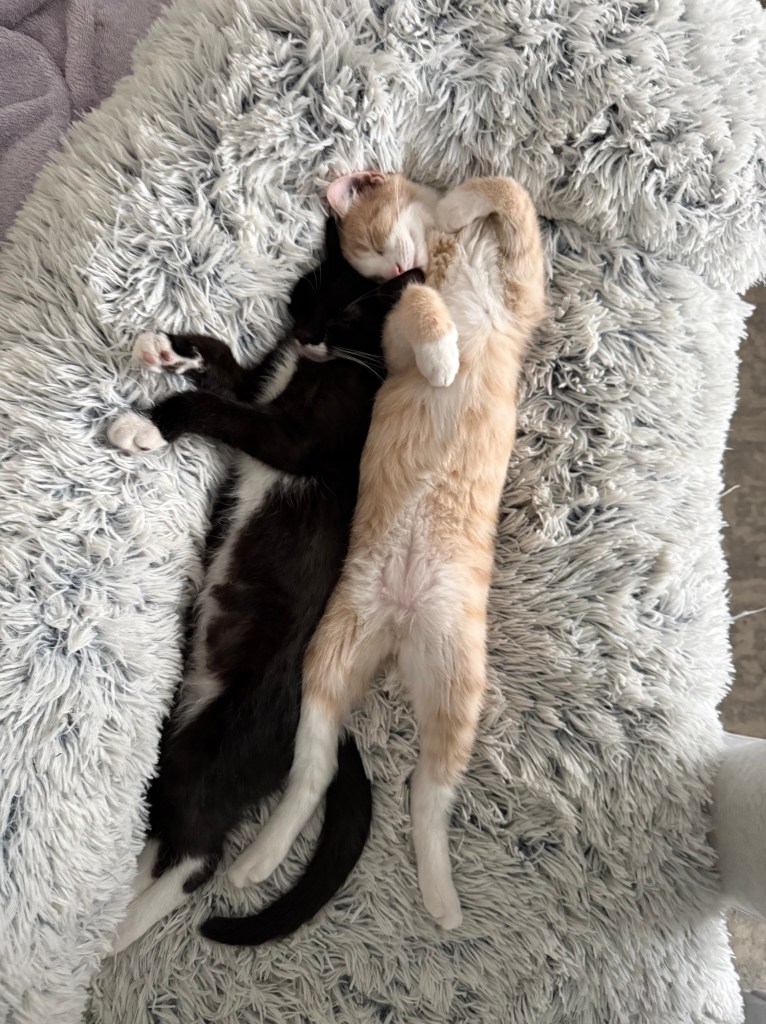
They have taken over the dog bed

Tears, Held

I recently came across a poem I wrote years ago. I cannot remember if I included it in my "younger Mom" blog, theabbeyfarm@blogspot.com.

Many of us are caretakers of others. Edith Stein was the German Jewish philosopher who became Sister Teresa Benedicta of the Cross, a nun who died in the Holocaust, who wrote beautifully about spiritual motherhood. Caretaking and nurturing is a spiritual vocation regardless of gender. I’ve said before that caretaking for one who is suffering from medical issues is extremely stressful. We choose to care because we love. It is a form of self-sacrifice, which is the greatest of all gifts. The incongruity of pain and joy existing at the same time is worthy to ponder. There is truth in it.

Tears, held.
The reservoir is tremendous,
Her banks home to many,
Her waters life-giving
And re-creational.

Resolve reinforced,
Cracks patched in the dam.
Laboring unheard,
She moans as trickles of water break through
And belie her humanity.

The force intensifies,
Floodgates open-
She wails!
But no one hears her amidst the rushing waters,
Amidst their outcries of changing tides.

Yet without such release
She would shatter irreparably,
Causing devastation to all.
She knows that responsibility-
It has become her.

The floodgates close once again,
The weight of the water returns on the dam.
And the work resumes, ever silent.
All Cheer!
The waters are contained.

She is her work;
Love, with the greatest purpose-
Life!
There is deep joy in this, even in labor.
Tears, held.

Patience

As a parent of ten children, the teen years have gone on in our home for a few decades now. There are wonderful things about these years, but there are challenges, as well. We’ve had some self-motivated, straight-A children, some who fall terribly behind and then a few in between. When the oldest are the high achievers, it is hard not to expect that the younger children will follow suit.

But they are each unique. And each deserves to be their own individual person, including what kind of student they are. They all need one-on-one time with their parents. This is more challenging in big families, but it must happen, even if it must be planned ahead. In a former blog I told stories of the many adventures on and off our Abbey Farm. Now we live on an Army Post and up until a couple months ago, had 6 (!) teens under one roof. The oldest recently turned twenty and is in the Army Reserves deciding on what college degree to pursue.

The fourteen-year-old has been making up school-work and was just in my room complaining about monotony. Oh, the many things I could have depressed him about in terms of monotony ahead in his future. I told him that he really was developing character, and that little jobs went a long way. Tidying up an area, taking a walk or bike ride. The twenty-year-old was home and I asked him to take his brother out for a drive, maybe get a milkshake. A change of scenery is always a good idea when we are in rumination mode.

For myself, I am in a bit of self-isolation, undergoing chemotherapy for breast cancer. It’s all been a shock of a summer, totally unexpected and I will neither elaborate, nor make light of it. A new normal begins once again. Much patience is required. I realize the importance of each of my children, and how I still want to be present in their lives while fighting a disease. They have all been supportive and reacted with such love and care and help. My husband has been my lifeline.

Friends have been so helpful, and some from long past have reconnected; it has been truly a gift. None of us looks forward to adversity, but in truth, it often sheds light on the very best things in life. It requires resilience through faith, a strong network of family and friends, and a lot of patience.

Corny

I’ve been asked, “Why Suzy Cornflakes?”

While I do live in a household full of Dad-jokes and corny jokes (thanks to my witty hubby and sons), the reference is actually to a cereal box from the early 1970s. I’ve searched online to find images of it, but with no luck.

Before even that box, in the 1960s the cereal called “Wheaties” became very popular. Full of whole wheat goodness, it was dubbed “The Breakfast of Champions.” Many may still remember the great sports heroes featured on the front of the boxes over the years. Prior to the famous folk, the boxes held images of cute little children because the cereal was marketed to parents who wanted a healthy breakfast for their kids. One of the children pictured was a cute little strawberry blond girl with freckles. The resemblance to me was not missed by my brothers, and one of my very first nicknames in life was: Wheatie.

Wheatie, 1966
Wheatie, 1968

A few years later we moved to Northern Baltimore County in Maryland, a very rural area with thousands of acres of farmland. One of our neighbors (I have mentioned him before) was Mr. Ballard. We went to the same church as his family, and worked together on the local, church-organized horseshows. His children were excellent riders and older than me. When I was a teen, and they were grown or in college, I helped clean Mr. and Mrs. Ballard’s house each week. At 16 I had sold my own pony, and by 18 I began to exercise his hunters. That subject is book-worthy, for I will never, ever forget the many experiences riding horses for and with “Mr. B.” He was more than an icon; in many ways he was my hero.

In the 1980s with Spindrift, Rathkeale and Justin

Back to cornflakes. Generic products became prolific with inflation of the 1970s, and big-name brands became too expensive for many household budgets. The market flourished with identical products, but in plainer packaging and cheaper pricing. Sometimes the manufacturer was one-in-the-same with the name brand, as is common today with store-brands. Popular “Kellogg’s Cornflakes” was rivaled by a generic box that I only remember as light-blue on the front, with the face of yet another adorable, strawberry-blonde, freckled little girl. Mr. B immediately nicknamed me: “Suzy Cornflakes.”

Halcion days, walking to and from the bus with my brother.

My brothers still call me Wheatie from time to time, but no one calls me Suzy Cornflakes anymore, since Mr. Ballard passed away several years ago. He was close to the age of 90 and I smile to think that he was probably on horseback not long before his passing. I will always remember him, grateful for the rides and the advice and support that only a very special and sage human being can gift to another…to a talkative, freckle-faced, strawberry-blonde adolescent.

Suzy Cornflakes will forever remember Mr. B.

A Special Chain Reaction

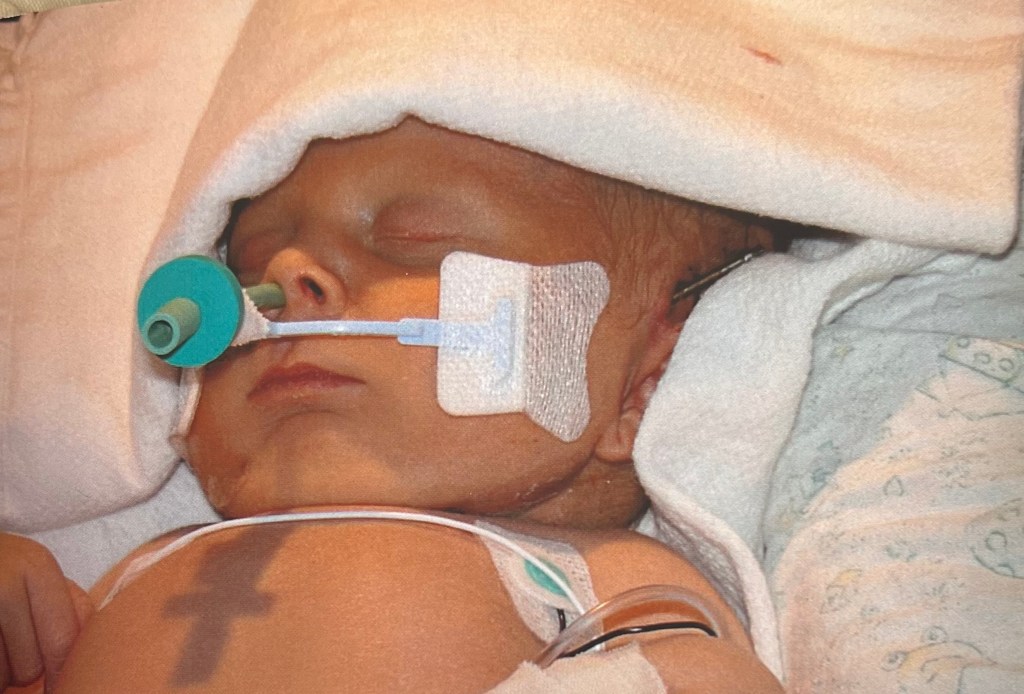
When Mary Pat was born with Pierre Robin Sequence we didn’t know if her physical deformities were the extent of her problems, or if she had other potentially associated disabilities as well.

In truth, we didn’t know if she would ever walk, or talk, or eat on her own, or even survive. It was harrowing for a few weeks, scary for a few months, and then for years we fell into a routine of care that was full of unknowns. She had multiple appointments each month, and therapists who came to the house two to three times per week.

A good friend of mine has six wonderful children. Her youngest was born with Down Syndrome about a year before Mary Pat. Quite a few times at a moment’s notice, she drove half an hour to help me replace Mary Pat’s tiny nasogastric tube. In tears, I felt as though I’d entered a new world — a new “club” — of parents with special needs children. Early on, though, my friend pointed out that the way she saw it, each one of her children had “special” needs. Each had needs quite unique to them. I was blessed by her wisdom.

I have referred to Mary Pat as our “special needs child” but perhaps I should rephrase this to “our child with special needs.” Why is it that I need to distinguish her at all from the others? Sometimes it is to emphasize her extra-ordinary needs, but I suppose it is often for ease of description. We have six daughters and four sons. The oldest four girls are sometimes referred to as our “oldest, second-oldest, third-oldest and fourth-oldest.”

Our sons are described similarly, and then Mary Pat as our daughter with “special needs” and Margaret as our “youngest.” Again, they each have their special, unique needs, and we love them dearly. Energy and time can be spread thin in large families, but the love multiplies exponentially.

If it is true that every child has their unique and special needs, then that oft-heard sentiment that only “certain types of parents” do well with such children is unfounded. We grow into what we are given or challenged with. I understand fear and even panic when learning that a child in the womb has a certain diagnosis which will significantly impact the course or length of their life, and which will significantly impact the family. But the truth remains that every single person I have known who raised such children, even those who lost them early, professes immense blessings, and gratitude for the effects of their children on their lives.

Just as profound are the effects of these children on others. Mary Pat wheeled herself around her elementary school when she became ambulatory with a walking device. She would visit the other classrooms and became known to all the other children. They learned about her, and her differences were demystified. She was welcomed and loved.

Mary Pat received handwritten cards from schoolmates throughout the years. One third grader told her that she wanted to be like her–happy all the time. Another said over the loudspeaker during morning announcements, that he was inspired by Mary Pat to go to college so that one day he could work with children like her.

Each of her caretakers have been touched by her life, and love her dearly.

Yes, it is true that more time, energy and resources are often needed for children like Mary Pat. But the world is a better place because of her, and those like her. They are endowed with grace that holds the potential to bring out the very best in us. They teach us about what is important in life. They evoke compassion, and spark an unstoppable chain reaction of love.

Suffer The Little Children

Some people have an innate gift with children. My friend Tracy and I were having coffee at a local restaurant and at the table next to us there was an adorable yet rascally little girl seated with her mother. The angelic strawberry blonde curls failed to mask the mischief in her eyes as she repeatedly pushed her drink off the table’s edge. The young Mom was as patient as a saint, repeatedly picking up and replacing the drink, only for the act to be repeated again with more gusto.

I have raised ten children, eight of them through this stage. I was tolerant and hid a smile but was willing to ignore it. The Mom was dealing with it better than I would have. But Tracy, an experienced elementary school educator made eye contact, then spoke animatedly with the little girl and her Mom. After a few minutes’ interruption of our coffee-time, the angel was restored to good behavior and the Mom was visibly thankful. Whether skill or experience, compassion or caring, Tracy was a gift to them.

How many of us go that extra mile? Some of us may not have the calling or skill in a particular instance, but we can watch for those who do, and we can wish for the good of others. I know that when we are in church and a child is raising a tantrum, the parent desperate, I pray so very hard for them. I have been there many times, sometimes vowing that I wouldn’t return to church until they were years-older. But there we were the next day, or the next Sunday. I know that hundreds of sermons drifted around and over my stressed-out head.

Least helpful were snorts of disapproval or bland stares. One elderly woman tried to make a case at church that there should always be a cry-room and that church was not the place for children. Thankfully, there was a cry-room to take inconsolable children, but the pastor disagreed and said that he wanted families together in church. Years later at a church we visited, the pastor stopped the service momentarily to address the parents of crying babies. He said not to feel flustered as this is what babies did. “Tend to their needs, and let’s all rejoice in the sound of life and of family and of Christians attending church despite difficulties.” Wow. Clearly, I’ve always remembered that.

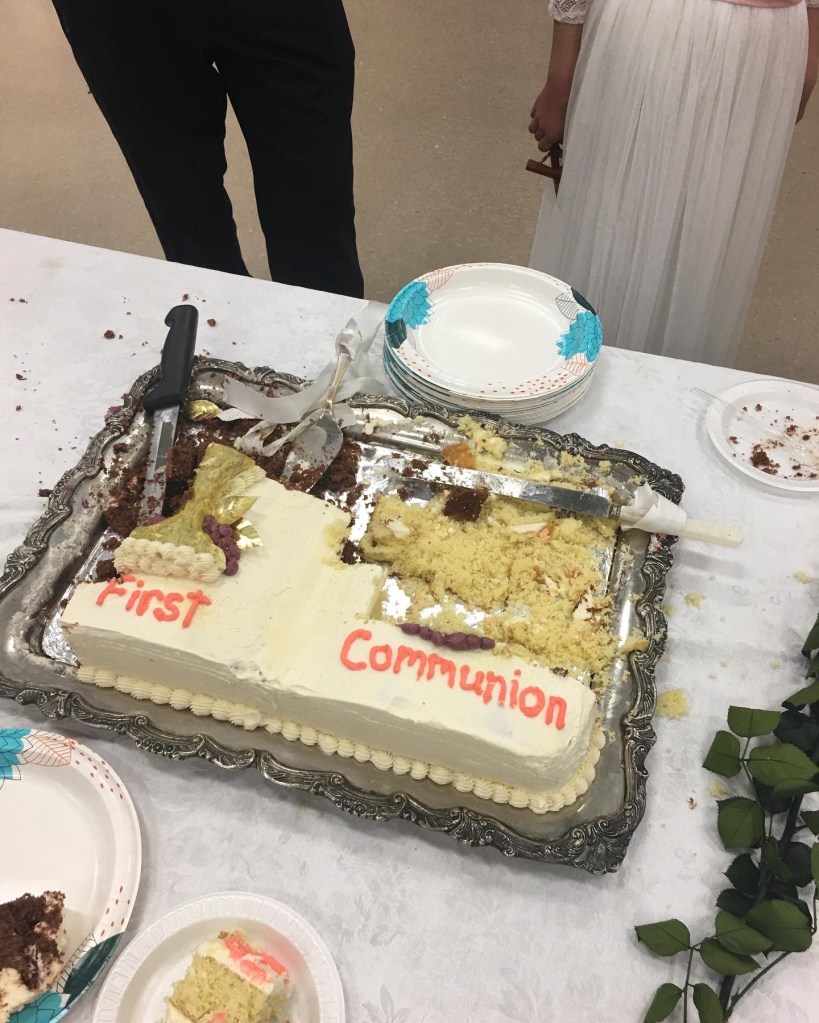
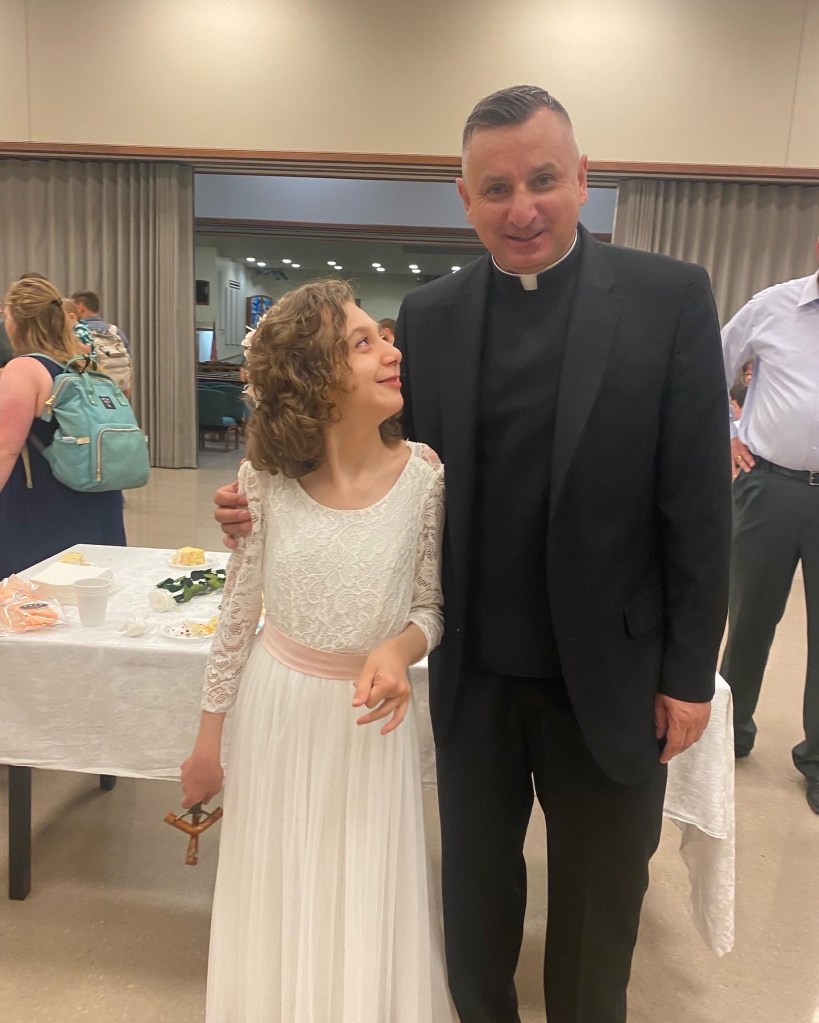
Our own new priest has made a point to say that our being in church to worship is all about Jesus and Jesus welcomed children. He has incorporated baptisms and other sacramental events into the Sunday Masses. A few weeks ago our special needs daughter had her first communion and it was beautiful. Everyone gathered afterward to celebrate with us. I made a cake.

Some might say that she didn’t understand what was going on, but we believe she did.

Jesus knew.

Pendulous Times

Changes in the last few decades in the United States in regard to marriage, the dignity of life, self-empowerment, feminism, abortion, and racial issues have been significant. They have caused many to become angry, worried or even depressed–whether they feel that there have been too many changes, or not enough fast enough.

World-view and personal philosophy fuels how we see things and react. I try to resist black-and-white, linear or negative philosophies. I have read and re-read the Bible. I pray and I trust God with any matter in which I am confused or even disappointed. I do not wish for “X” country to be “nuked,” or for those “Y” people to go to hell. I do not believe that violent acts are the answer. In the big picture I believe that God’s got this. He is Love and therefore He is just and merciful. I still see much good in this world.

It is not relativistic to acknowledge that we are living in time. If there are alternate realities or eternity, well, we are still here and we cannot avoid the passage of time, aging and death. Our cultural climate will shift with time. My mind often analyzes concepts in images. The image of a pendulum helps grapple with the world and its polarized right/left, political and philosophical extremes. I think of the constantly moving, never static Focault Pendulum we visited as schoolchildren at the Smithsonian Institute in Washington, DC.

Standing on a high floor, looking over the railing we all stared, mesmerized, as the 50-foot-long pendulum swung slowly through the center of a large circle on the floor below below, reaching out to a point on the perimeter to knock over a pin at its furthest reach. It seemed still for a moment, but then reversed, and headed in the opposite direction to repeat the process, back and forth, slowly rotating round and round, eventually knocking over every pin on the circumference of the circle. The point of the exhibit was to prove that the earth rotated, but I believe that it can serve as a metaphor to grapple with the times, and to argue for love.

Throughout tragic events in history (slavery, concentration camps, genocides) there arose incredible individuals who led others, who helped and inspired despite their horrid circumstances. Fred Rogers famously quoted his mother’s advice, that in troubled times he should “look for the helpers.” Look for the heroes who inspire.

The pendulum reminds me that times will indeed change. It passes through the middle all too swiftly, where there could be more understanding and compromise. Times may shift as significantly as we’ve seen politically in the United States from one extremely different President to another. At one far reach of the pendulum of time something is outlawed, but at the opposite it becomes legal.

Be patient. There is a way through whatever mess you see. Heroes will indeed emerge. Maybe you are one of them. Keep focused on the good that still exists, and strive for love and understanding. The ability to have compassion and to stand in another person’s shoes makes life much more meaningful and full of hope. Love not only endures throughout the languorous swing of the pendulum through time, but it heals, and it brings us all closer to God.

Polyanna

If you have not seen the movie Polyanna with Haley Mills and Richard Egan, I recommend it highly. It is a children’s movie adapted from the book of the same title by Eleanor H. Porter. It is entertaining and moving. Polyanna is an orphan who goes to live with a wealthy aunt. Her life has been very difficult and yet she has adopted an attitude of gratitude and positivity that is her strength, and far from annoying, becomes inspirational to all who know her.

The word Polyanna has since been used as an adjective to describe unrealistic, starry-eyed idealism. Toxic positivity is a more modern and extreme concept today, purposely ignoring the actual distress of what another is going through. It is more dismissive than just a lack of social grace. I propose that ignorant bliss and the slang, synonymous interpretation of Polyanna is at one end of a positive philosophy, and toxic positivity is at the other. Both are extremes. At the center is a more balanced state, the actual example of the character Polyanna, and perhaps it is very much needed at this time.

I feel immensely blessed by friends from so many different walks of life. Rather than surround myself only with those who adhere to my beliefs, I am challenged by friends who have different theologies, philosophies and world views. Throughout the political ping-pong match of the last few decades in the United States I have witnessed a similar back-and-forth of reactions by those who hold one view or another. My prayer has been in each instance that hearts will remain hopeful, wills determined, anger channeled constructively, and heads cool. For those who are relieved or exuberant with various changes, I hope that they have compassion, not contempt, for those who feel the opposite.

In the news and on social media we see too many instances of rudeness and hatred. The constant presence of negativity on our televisions, computers and hand-held devices does great damage–if we let it. Fake news, strawman arguments and false narratives abound. If evil has a persona then its greatest tactic is to divide, then stand back and watch us destroy each other.

We can resist. We can strive to maintain peace and hope in our homes and communities. We can be more like Polyanna and inspirational, historical figures who despite poor odds and circumstances worked steadfastly, lovingly and peacefully for the good of others.

A Great Man

After four daughters, I had a son, and contemplated the enormity of raising a boy. My friend wrote some Bible verses for me in a card and one stood out: In Genesis 4 Eve says: “I have borne a man with the help of the Lord.” A man?

I have thought about this throughout his childhood, as well as those of his three brothers. Some may say that gender does not matter, that we raise them the same, as people with integrity. I agree with that premise in regards to raising confident, intelligent, loving children regardless of gender. But there simply are differences in individuals, and in order to prepare our children for the world they live in we need to prepare, teach and enculturate them realistically. We may do these things differently from family to family, but we do so ideally with the best of intentions, with love and caring of not only them but of the world.

When my oldest daughter married a wonderful young man I asked his advice. What did his Mom do so obviously well? He thought about it and replied, “You know, I don’t think anything, except love me. I always knew she was there for me, and that was important as I navigated the tough things growing up.”

Loving has never been hard for me, especially for my children; yet life is so very hard on them these days.

We teach our boys to consider good examples of men. Is a great man one who makes profound societal changes, who has statues erected in his honor? Is his behavior impeccable, does he invent history-changing devices, amass great wealth, or become known the world over?

Most often not. So what truly defines him? What is the essence of him, what causes the best to come forth from him?

Some would answer that it is his character, but even that is fueled by something deeper. His world view? His philosophical precepts? His religion? Many things are important, yet the “greatest is love,” Jesus said. Buddha taught that peace was the goal, but peace can only exist in its purest form in love–certainly not in anger, hatred, selfishness or divisiveness. The latter is tragically so prevalent in the world our children see.

And so I think of my father and my husband’s father as I teach my boys. A great man loves what is true. He loves his family, he loves others–he even loves his enemy when it comes right down to it. He is afraid at times, yet relies on an inner wellspring of peace, and a love of what is right. He has continence– that is, self-control. If he fights it is truly a last resort, and it is not out of hatred, but for whom he protects and loves. He will make mistakes, and he may remain unknown, without great impact, or statues, or inventions or wealth or fame, but he has integrity and love of fellow man. He helps those in need and offers kind smiles. 

I teach them that though our effect on the world may seem imperceptible, like a ripple in the vast water, we persevere in love. We put one courageous foot in front of the other, because each ripple will combine with others to become waves that have power to move the earth.  

The Forgotten Verse

Are traditional roles less valued these days? Some would say yes, but I would say the answer depends on with whom we surround ourselves. I am thankful for friends who have very different lives and beliefs than mine. They help me to understand others better, as I realize I can still be egocentric or ethnocentric. My thirst for knowledge includes wanting to understand others more fully.

Humans tend toward confirmation bias. It makes sense in that our brains work to organize information into understandable sets and subsets. When we surround ourselves with primarily like-minded folk we become complacent in the thought that most people must think like we do. I see this in my politically divided friends as well as my religiously divided friends. To be aware of this tendency perhaps can fuel us on toward seeking more information and understanding.

I have seen a distaste for traditional marriage services when the bride is asked if she will “obey” or “be subject to” her husband. “Wait a minute–hold on right there! That is antiquated and dominating and…” a host of balking descriptors follow.

We are a more civilized and advanced society, and even if we have light-years to go in eradicating racism and prejudice of every sort, we can agree that the imposition of one’s will with the intent to intimidate, dominate or enslave another is morally wrong. So why would anyone in this day and age agree to “obey” a spouse?

The answer lies in the context of the liturgical reference. The pledge is taken from the book of Ephesians in the Bible. The fifth chapter is all about Christlike love. What is that? Well, most agree that Jesus did live. It is who he was and who he claimed to be on which people differ–but that does not matter in what I am reasoning here. Whomever he was, he died in a sacrificial way for his followers and beliefs. Selflessness was “the way.” The ultimate sacrifice of his life to save his friends was a culmination of this way of life, of turning the other cheek, of giving, and of putting the needs of another first.

Ephesians chapter five is about living in love and about the giving of oneself to others and to God. Wives are asked to be subject to their husbands–yet here’s the catch, the forgotten part– and the husband is exhorted to treat “his wife as Christ is the head of the church, its Savior.” There is more about how the husbands are to behave, to “love your wives as Christ loved the church and gave himself up for her that he might sanctify her…husbands should love their wives as their own bodies…” In its whole it is about introducing total (self-donative) love into marriage. For the unmarried or those in other relationships, the call is no less; it is to “love your neighbor as yourself.”

Taken out of context, the phrasing hints at domination. Taken in context, it alludes to self-sacrificial love, of wanting the best for the other. Sure, humans throughout the ages have messed it up and misapplied the words in dreadful ways. But it is neither the words nor the truths intended that are messed up, it is the people who chose to ignorantly use them. Such a love should should flow both ways, though at times one must decide whether or not to continue to give when the other in the relationship is habitually not doing so. If someone in a relationship is being taken advantage of or is abused, that person should seek help and counsel. Abuse is not love.

My husband and I are “subject to each other” in our shared lives. We make mistakes, we go to each other for advice, we critique each other–in love. Perhaps you have heard the saying “Iron sharpens iron, and so a friend counsels a friend.” That comes from another verse in Proverbs, and it applies here. Sharpening hurts even when done in love, but done so in love makes us grow and stretch and become better persons. We can choose not to help our friend for whatever reason, but in the end would that be loving?

All is hinged in this traditional pledge, and perhaps in life itself, on a forgotten verse that comes from a dynamic chapter describing and exhorting us to love each other the best way possible: selflessly not selfishly.